
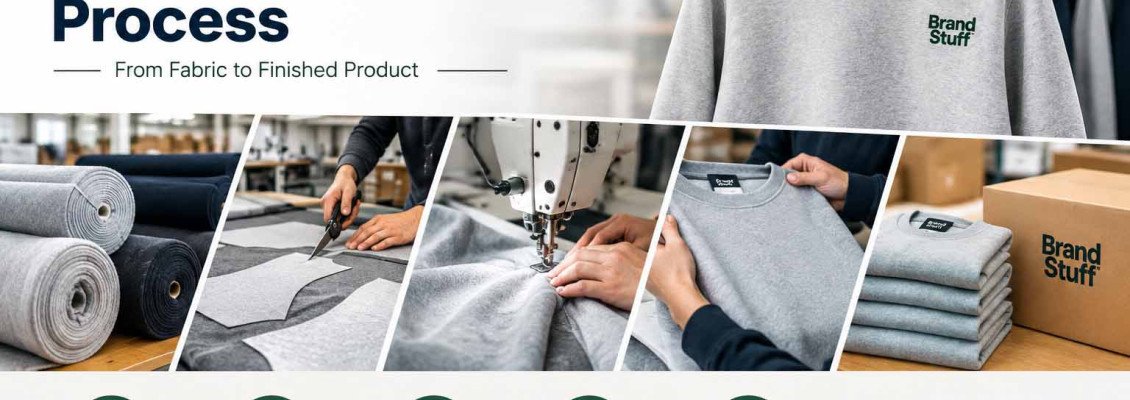
Step-by-Step Sweatshirt Production Process: From Design to Bulk Manufacturing
A sweatshirt may look like a simple garment, but producing a high-quality custom sweatshirt involves many individual stages.
For a streetwear brand, private-label clothing company, retailer, or fashion startup, understanding the sweatshirt production process can make it easier to communicate with a manufacturer, control costs, approve samples, and maintain consistent quality during bulk production.
A professional custom sweatshirt manufacturing process normally starts with design specifications and a tech pack, followed by fabric sourcing, pattern development, sampling, fabric inspection, cutting, sewing, printing or embroidery, finishing, quality control, and packing.
In this guide, we'll explain the step-by-step sweatshirt production process, including what happens at each stage and what clothing brands should check before approving bulk production.
Step-by-Step Sweatshirt Production Process
The typical custom sweatshirt production workflow includes:
Design and specification review
Tech pack preparation
Fabric selection and sourcing
Color and trim development
Pattern making
Sample development
Sample fitting and revisions
Pre-production approval
Fabric inspection and relaxation
Fabric cutting
Panel preparation
Embroidery and printing
Sewing and garment assembly
Labels and branding
Washing and finishing
Measurement checking
Quality control
Folding and packaging
Final inspection
Bulk shipment
Let's look at each stage in detail.
1. Design and Sweatshirt Specification Review
Every successful sweatshirt manufacturing project starts with a clear understanding of the product.
Before production begins, the manufacturer reviews the design and determines how the garment should be constructed.
What Does a Manufacturer Review?
Important specifications can include:
Sweatshirt style
Fit
Fabric composition
GSM
Color
Size range
Measurements
Rib specifications
Stitching details
Pockets
Artwork
Embroidery
Printing
Labels
Packaging
For example, a streetwear brand may request a 400 GSM oversized cotton fleece sweatshirt with dropped shoulders, ribbed cuffs, custom embroidery, and a woven neck label.
These details directly affect manufacturing requirements and pricing.
Why Clear Specifications Matter
A manufacturer cannot accurately produce a custom garment if important details are missing.
Clear specifications help reduce:
Sampling errors
Material substitutions
Measurement problems
Unexpected production costs
Branding mistakes
Bulk production revisions
The Manufacturer's Initial Review
During the initial review, the manufacturer can identify potential production issues before sampling begins.
This is particularly important for complex garments involving heavyweight fabric, garment washing, embroidery, appliqué, unusual construction, or oversized proportions.
Start With a Production-Ready Specification
The more complete your specifications are, the easier it becomes to move from design concept → sample → approved production → bulk manufacturing.
2. Create or Finalize the Sweatshirt Tech Pack
A tech pack acts as the manufacturing blueprint for your sweatshirt.
For brands developing custom products, it should communicate exactly how the sweatshirt should be produced.
What Should a Sweatshirt Tech Pack Include?
A professional tech pack may include:
Front and back technical drawings
Size chart
Measurement specifications
Fabric composition
GSM
Pantone colors
Stitching details
Rib specifications
Artwork
Print placement
Embroidery placement
Label specifications
Packaging requirements
Washing instructions
Construction details
If you are creating a custom sweatshirt for your clothing brand, our guide on How to Create a Tech Pack for Custom Hoodies is also useful because many of the same technical principles apply to sweatshirts.
Why Measurements Are Important
A sweatshirt tech pack should specify measurements for each required size.
For example:
Chest width
Body length
Shoulder width
Sleeve length
Cuff opening
Bottom opening
Neck width
Armhole
Pocket dimensions
Measurement tolerances should also be established.
Pantone and Color References
For custom colors, brands can provide Pantone references.
This helps the manufacturer understand the intended color rather than relying only on a digital screen image.
Artwork Files
Vector artwork such as AI, EPS, or PDF files can help manufacturers prepare embroidery and printing accurately.
3. Choose the Right Sweatshirt Fabric
Fabric selection is one of the most important stages of sweatshirt manufacturing.
The fabric affects:
Weight
Warmth
Hand feel
Durability
Structure
Shrinkage
Cost
Appearance
Common Sweatshirt Fabrics
Cotton Fleece
Cotton fleece is popular for heavyweight streetwear sweatshirts.
Typical applications include:
Oversized sweatshirts
Premium streetwear
Winter collections
Luxury casualwear
French Terry
French terry has a looped interior and can provide a lighter, more breathable feel.
It is commonly used for:
Spring collections
Lightweight sweatshirts
Premium casualwear
Tracksuits
Cotton-Polyester Blends
Blended fabrics can provide benefits such as:
Shape retention
Durability
Reduced shrinkage
Different performance characteristics
Fabric selection should always be based on the intended product rather than GSM alone.
Understanding GSM
GSM means grams per square meter.
Common sweatshirt weights include:
GSM Typical Application
280–300 GSM Lightweight sweatshirt
320–360 GSM Premium everyday sweatshirt
380–420 GSM Heavyweight streetwear
450+ GSM Ultra-heavyweight sweatshirt
Actual fabric behavior also depends on composition, construction, finishing, and processing.
4. Fabric Sourcing and Color Development
Once the fabric specification has been approved, the manufacturer sources the required material.
Custom Color Development
If the brand requires a specific color, the manufacturer may need to develop the color based on a Pantone reference.
This can involve:
Color reference submission
Lab dip development
Color comparison
Approval
Bulk dyeing
Why Custom Colors Can Increase Lead Time
Custom dyeing can require additional development and approval time.
This is especially relevant for brands ordering unusual colors or smaller quantities.
Fabric Testing
Depending on the product, manufacturers may evaluate:
GSM
Composition
Color
Shrinkage
Colorfastness
Hand feel
Dimensional stability
5. Sweatshirt Pattern Making
Once the design and fabric specifications are confirmed, the pattern is developed.
Pattern making converts the technical design into individual fabric pieces that can eventually be cut and sewn.
Main Sweatshirt Pattern Pieces
Depending on the design, these can include:
Front body
Back body
Sleeves
Cuffs
Waistband
Neck rib
Pocket
Pocket binding
Panels
Developing Oversized Sweatshirt Patterns
Oversized streetwear garments require careful attention to proportions.
Important areas include:
Dropped shoulder
Chest width
Body length
Sleeve width
Sleeve length
Armhole
Cuff width
Bottom opening
Size Grading
After the base size is developed, the pattern can be graded into the required sizes.
For example:
S → M → L → XL → XXL
The grading must maintain the intended silhouette across the entire size range.
Why Pattern Accuracy Matters
A high-quality fabric cannot compensate for an inaccurate pattern.
Pattern development therefore plays a major role in achieving the intended fit.
6. Sweatshirt Sample Development
Before bulk production, a sample is normally developed.
The sample allows the brand and manufacturer to evaluate the actual product rather than relying only on drawings.
What Is Checked During Sampling?
The sample can be evaluated for:
Fit
Measurements
Fabric
GSM
Color
Stitching
Rib
Print
Embroidery
Labels
Pocket position
Overall appearance
Sample Revisions
If something needs changing, the manufacturer can revise:
Pattern
Measurements
Fabric
Color
Artwork
Branding
Stitch construction
Why Sampling Matters
Sampling allows problems to be identified before hundreds of garments are produced.
For more information about prototype and PPS development, see our Hoodie Sampling Guide: Proto, PPS & Bulk Production.
7. Sample Approval and Pre-Production Confirmation
Once the sample is complete, the brand reviews it.
The manufacturer should receive clear confirmation before bulk production begins.
What Should Be Approved?
The brand should confirm:
Fabric
Color
Fit
Measurements
Artwork
Embroidery
Print
Labels
Packaging
Washing treatment
Why a PPS Sample Can Be Useful
For larger production orders, a Pre-Production Sample (PPS) can provide a final physical reference before bulk manufacturing.
A PPS can use the intended bulk fabric, colors, trims, and branding methods.
8. Fabric Inspection and Relaxation
Before cutting, the fabric should be prepared for production.
Fabric Inspection
The manufacturer can check for:
Holes
Stains
Color variation
GSM variation
Knitting defects
Surface problems
Fabric Relaxation
Knitted fabrics may require relaxation before cutting.
This helps stabilize the material and can reduce dimensional changes after cutting.
Why This Stage Matters
Cutting unstable fabric can create problems with:
Measurements
Panel dimensions
Garment symmetry
Final fit
9. Sweatshirt Fabric Cutting
After the fabric has been prepared, the production team creates the required fabric panels.
Pattern Placement
Patterns are arranged to maximize fabric utilization while maintaining the correct grain and direction.
Cutting
The fabric layers are cut according to the approved production patterns.
Cut pieces are then organized according to:
Size
Color
Garment
Panel
Cutting Accuracy
Accurate cutting helps ensure that the final sweatshirt maintains the approved measurements and proportions.
10. Embroidery and Printing
Branding can be applied at different stages depending on the construction and decoration technique.
Embroidery
Embroidery is commonly used for:
Chest logos
Sleeve logos
Small brand marks
Premium branding
The embroidery file is digitized before production.
Screen Printing
Screen printing works well for:
Large graphics
Bold artwork
Multiple garments
Streetwear collections
Puff Printing
Puff printing creates a raised three-dimensional effect and is popular for premium streetwear.
DTG and DTF
Digital printing methods can be useful for:
Detailed graphics
Small production runs
Complex artwork
Placement Accuracy
The production team should follow the approved artwork dimensions and placement measurements.
11. Sweatshirt Sewing and Garment Assembly
This is where individual panels become a finished sweatshirt.
Typical Sewing Sequence
The exact sequence depends on construction, but may include:
Joining front and back panels
Attaching shoulders
Setting sleeves
Closing side seams
Attaching cuffs
Attaching waistband
Installing neckline
Attaching pocket where applicable
Final seam inspection
Stitching Quality
Production teams should monitor:
Seam strength
Stitch density
Seam allowance
Thread tension
Straightness
Loose threads
Reinforcement
High-stress areas may require reinforcement to improve durability.
12. Private Label Branding and Labels
Private-label sweatshirt production normally includes several branding components.
Neck Labels
Options can include:
Woven labels
Printed labels
Satin labels
Damask labels
Care Labels
Care labels may contain:
Fiber composition
Washing instructions
Size
Country of origin
Brand information
Hang Tags
Custom hang tags can reinforce the brand identity and provide product information.
Custom Packaging
Depending on the brand, packaging can include:
Custom polybags
Zip bags
Tissue paper
Stickers
Branded boxes
13. Washing and Finishing
Some sweatshirt collections require additional finishing after sewing.
Common Sweatshirt Finishes
Depending on the design, manufacturers may use:
Garment wash
Enzyme wash
Pigment dye
Vintage wash
Softening
Brushing
Special finishing
Why Washing Requires Control
Washing can affect:
Color
Hand feel
Shrinkage
Measurements
Surface appearance
This is why washing specifications should be confirmed before bulk production.
For a deeper explanation of how shrinkage affects garment measurements and bulk production, see Hoodie Shrinkage Explained: Fabric, Fit & Bulk Production.
14. Sweatshirt Quality Control
Quality control is one of the final and most important production stages.
A professional sweatshirt quality control process should compare finished garments against the approved specifications.
Fabric Quality Checks
Inspect:
Fabric composition
GSM
Color
Surface
Defects
Shrinkage where applicable
Measurement Checks
Measure:
Chest
Length
Shoulder
Sleeve
Cuff
Hem
Neck
Construction Checks
Inspect:
Seams
Stitching
Rib attachment
Thread trimming
Pocket construction
Symmetry
Branding Checks
Inspect:
Logo size
Logo placement
Embroidery quality
Print quality
Label placement
Hang tags
For a more detailed B2B inspection approach, see our Custom Hoodie Quality Control: 15-Point B2B Checklist.
15. Final Measurement and Defect Inspection
Before packing, finished garments should be inspected.
Measurement Tolerance
Every garment cannot always be mathematically identical because textile production involves fabric and sewing tolerances.
The brand and manufacturer should therefore agree on acceptable measurement tolerances.
Common Defects to Check
Inspect for:
Holes
Stains
Loose threads
Broken stitches
Uneven seams
Incorrect labels
Print defects
Embroidery defects
Color variation
Measurement problems
Final Appearance
The sweatshirt should also be checked visually against the approved sample.
16. Folding, Packaging and Carton Packing
Once garments pass inspection, they can be prepared for shipment.
Individual Packaging
Depending on the brand, each sweatshirt may be:
Folded
Tagged
Polybagged
Barcode labeled
Carton Packing
Garments are then packed into cartons according to the agreed packing requirements.
Cartons may be separated by:
Size
Color
Style
Shipment Preparation
The manufacturer prepares the final shipment according to the agreed shipping method.
17. Final Shipment
After production and final quality control are complete, the order is prepared for dispatch.
Depending on the destination and order size, brands may use:
Express courier
Air freight
Sea freight
Airport-to-airport shipping
DDP shipping
EXW arrangements
The appropriate option depends on the destination, quantity, urgency, and budget.
How Long Does Sweatshirt Manufacturing Take?
The production timeline depends on:
Fabric availability
Custom dyeing
Sampling
Number of revisions
Artwork complexity
Embroidery
Printing
Washing
Order quantity
Packaging requirements
Typical Production Stages
Production Stage Main Activity
Design review Specifications confirmed
Tech pack Technical details finalized
Fabric sourcing Fabric selected
Pattern making Production pattern developed
Sampling Prototype produced
Approval Sample and specifications approved
Cutting Bulk fabric cut
Sewing Garments assembled
Branding Printing/embroidery
Finishing Washing/trimming
QC Final inspection
Packing Garments packed
Shipping Order dispatched
Actual timelines should always be confirmed based on the specific product and order quantity.
Common Mistakes Brands Make During Sweatshirt Production
Choosing Fabric Based Only on GSM
Higher GSM does not automatically mean better quality.
Fiber composition, construction, finishing, hand feel, shrinkage, and durability also matter.
Skipping the Sample
Skipping sampling can create expensive problems during bulk production.
Not Providing Clear Measurements
Vague fit descriptions such as "oversized" or "relaxed" are less useful than actual measurements.
Ignoring Shrinkage
Shrinkage can affect the final garment dimensions and fit.
Approving Digital Colors Without a Physical Reference
Screen colors can vary between devices.
Changing Specifications During Production
Late changes can create additional development time, material waste, and production delays.
What Should You Send to a Sweatshirt Manufacturer?
Before requesting a quotation, prepare as much information as possible.
Recommended Production Information
Send:
Technical drawings
Tech pack
Size chart
Fabric composition
GSM
Pantone codes
Artwork
Embroidery files
Print specifications
Label artwork
Quantity
Size breakdown
Colorways
Packaging requirements
Delivery destination
If You Don't Have a Complete Tech Pack
You can still approach a manufacturer with:
Design mockups
Reference images
Fabric preference
Desired GSM
Measurements
Logo files
Quantity
The manufacturer can then identify the information still required for sampling and production.
Why Choose a Custom Cut-and-Sew Sweatshirt Manufacturer?
A cut and sew sweatshirt manufacturer can develop garments specifically around a brand's requirements rather than simply decorating an existing blank sweatshirt.
Custom Cut-and-Sew Advantages
This approach allows brands to control:
Pattern
Fit
Fabric
GSM
Color
Construction
Rib
Branding
Labels
Packaging
Who Uses Custom Sweatshirt Manufacturing?
Custom production is commonly used by:
Streetwear brands
Private-label clothing brands
Fashion startups
Fitness brands
Lifestyle brands
Retailers
E-commerce brands
Corporate clothing companies
Sweatshirt Production Checklist for Clothing Brands
Before starting bulk manufacturing, confirm the following.
Design
Final design approved
Technical drawings complete
Size range confirmed
Colorways confirmed
Fabric
Composition confirmed
GSM confirmed
Fabric construction confirmed
Color approved
Shrinkage considered
Branding
Logo artwork approved
Print method confirmed
Embroidery confirmed
Neck label approved
Care label approved
Hang tag approved
Sample
Sample received
Measurements checked
Fit approved
Fabric approved
Branding approved
Revisions completed
Bulk Production
Production quantity confirmed
Size breakdown confirmed
Bulk fabric approved
Production specifications locked
QC requirements confirmed
Packaging confirmed
Shipping method confirmed
Frequently Asked Questions About Sweatshirt Manufacturing
How are sweatshirts manufactured?
Sweatshirts are generally manufactured through a sequence of design review, fabric sourcing, pattern making, sampling, cutting, sewing, branding, finishing, quality control, packaging, and shipment.
What fabric is best for heavyweight sweatshirts?
Cotton fleece is a popular choice for heavyweight streetwear sweatshirts because it can provide warmth, structure, and a soft hand feel. The appropriate fabric depends on the intended fit, season, price point, and performance requirements.
What GSM is good for a premium sweatshirt?
Around 320–400 GSM is commonly used for premium and heavyweight sweatshirt styles, although the ideal GSM depends on the design and intended market.
What is a cut-and-sew sweatshirt?
A cut-and-sew sweatshirt is developed from fabric that is cut into individual pattern pieces and then sewn together according to a custom pattern.
Do I need a tech pack to manufacture sweatshirts?
A tech pack is highly recommended for custom production because it gives the manufacturer detailed information about measurements, fabric, colors, construction, branding, and other requirements.
How many samples should I order before bulk production?
The number depends on the complexity of the product and the number of revisions required. At minimum, brands should approve a sample that accurately represents the intended bulk specifications before starting production.
Can sweatshirt manufacturers make custom colors?
Yes. Manufacturers can develop custom colors based on suitable color references such as Pantone codes, subject to fabric type, dyeing method, MOQ, and development requirements.
Can I add embroidery to a custom sweatshirt?
Yes. Embroidery can be applied to areas such as the chest, sleeve, back, or other suitable locations depending on the design.
Can sweatshirts be garment washed?
Yes. Garment washing can be used to achieve particular softness, color, or vintage effects. The washing process needs to be defined and tested because it can affect measurements and appearance.
How do I control sweatshirt shrinkage?
Use appropriately processed fabric, test dimensional stability, control washing and drying conditions, and account for expected changes during pattern and production development.
What is private-label sweatshirt manufacturing?
Private-label sweatshirt manufacturing means producing sweatshirts for a brand using the brand's specifications, labels, artwork, packaging, and other branding requirements.
What should I check before approving bulk sweatshirts?
Check the approved sample, fabric, GSM, measurements, fit, color, stitching, embroidery or printing, labels, packaging, and applicable washing or shrinkage requirements.
Final Thoughts: Understanding the Sweatshirt Production Process
Producing a quality sweatshirt involves much more than cutting fabric and sewing panels together.
A successful custom sweatshirt production process depends on careful planning at every stage, from the initial design and fabric selection through pattern making, sampling, bulk cutting, sewing, branding, finishing, and quality control.
For clothing brands, the most important principle is to finalize the specifications before bulk production begins.
A clear tech pack, approved sample, suitable fabric, accurate pattern, controlled production process, and documented quality checks can help reduce manufacturing problems and create a more consistent finished product.
Whether you're launching your first streetwear collection or scaling an established private-label clothing brand, understanding how sweatshirts are manufactured gives you better control over quality, timelines, and production decisions.
Ready to Manufacture Your Custom Sweatshirt?
If you're developing a custom sweatshirt, heavyweight streetwear sweatshirt, or private-label collection, Brand Stuff can help with the complete manufacturing process, from fabric sourcing and pattern development to sampling, embroidery, printing, labels, bulk production, and quality control.
We manufacture custom apparel for brands and B2B buyers with in-house pattern making, cutting, stitching, printing, embroidery, and quality control.
Send us your sweatshirt mockup, tech pack, reference images, fabric requirements, quantity, and target destination to discuss your project and receive a production quotation.
Start your custom sweatshirt project with Brand Stuff today.
Leave a Comment