
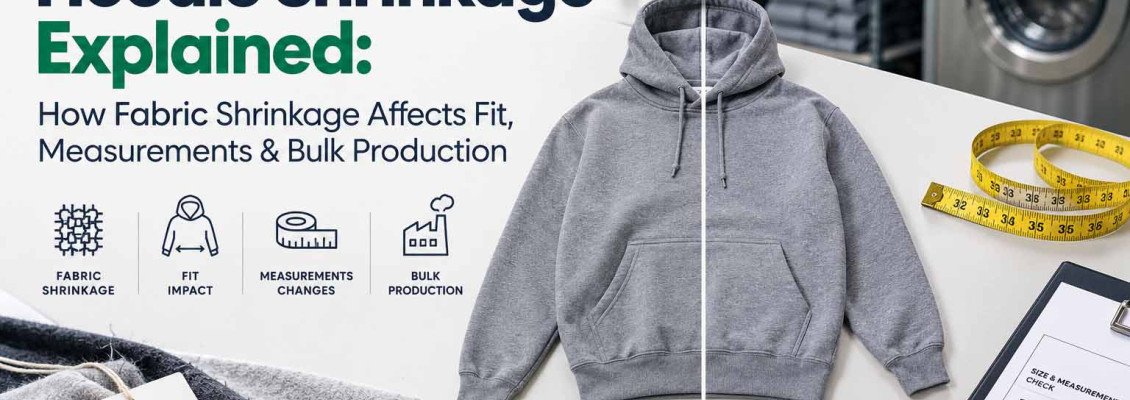
Hoodie Shrinkage Explained: How Fabric Shrinkage Affects Fit, Measurements & Bulk Production
Fabric shrinkage is one of the most overlooked factors in custom hoodie manufacturing. A hoodie can have the correct pattern, GSM, measurements, and stitching specifications during development, yet still end up smaller or differently shaped after washing if fabric shrinkage has not been properly considered.
For streetwear brands, private-label clothing companies, retailers, and B2B buyers, understanding hoodie fabric shrinkage is essential for maintaining consistent sizing between samples and bulk production.
Cotton fleece, French terry, brushed fleece, and other knit fabrics can experience dimensional changes during washing, drying, dyeing, and finishing. If those changes are not controlled, the final hoodie may have differences in body length, chest width, sleeve length, or overall fit.
This guide explains how hoodie shrinkage works, how manufacturers test and control it, and what B2B buyers should check before approving bulk production.
What Is Hoodie Fabric Shrinkage?
Hoodie fabric shrinkage is the dimensional reduction that occurs when fabric or a finished garment becomes smaller after processes such as washing, drying, steaming, dyeing, or finishing.
Shrinkage is normally discussed in percentage terms.
For example, if a hoodie body measures 70 cm before washing and measures 68.6 cm afterward, the length has decreased by approximately 2%.
For custom hoodies, shrinkage can affect:
Body length
Chest width
Shoulder width
Sleeve length
Hood dimensions
Cuff dimensions
Bottom opening
Pocket placement
Overall silhouette
For this reason, shrinkage control in hoodie manufacturing should be considered during pattern development rather than after bulk production begins.
Why Does Hoodie Fabric Shrink?
Textile fibers and knitted structures can relax during wet processing and drying.
Cotton is particularly important because cotton fibers can change dimensions when exposed to moisture, heat, mechanical action, and drying.
The manufacturing process itself can also influence the final dimensional stability of the fabric.
Factors include:
Fiber composition
Yarn construction
Knitting structure
Fabric GSM
Dyeing process
Finishing process
Mechanical relaxation
Washing temperature
Drying method
Garment-washing process
Cotton Hoodies and Shrinkage
Cotton hoodies can be more sensitive to shrinkage than garments made from certain synthetic fibers.
This does not mean that every cotton hoodie will shrink significantly. The actual result depends on how the fabric was produced, processed, finished, and tested.
A properly controlled cotton fleece fabric can provide much better dimensional stability than untreated or poorly finished fabric.
Does Higher GSM Mean More Shrinkage?
Not necessarily.
A 400 GSM heavyweight hoodie does not automatically shrink more than a 300 GSM hoodie simply because it is heavier.
GSM describes fabric weight per square meter. Shrinkage is influenced by the fiber, construction, finishing, relaxation, and processing conditions.
For example, a heavyweight cotton fleece hoodie may have excellent dimensional stability if its fabric has been properly processed and tested.
The Relationship Between GSM, Construction and Shrinkage
GSM should therefore be considered together with:
Fiber composition
Knit construction
Yarn quality
Fabric finishing
Pre-shrinking or stabilization
Washing method
Drying method
Testing results
This is why B2B buyers should avoid selecting hoodie fabric based on GSM alone.
How Much Do Hoodies Typically Shrink?
There is no single shrinkage percentage that applies to every hoodie.
A realistic shrinkage result depends on the specific fabric and processing method.
For production purposes, manufacturers should establish the actual shrinkage percentage through testing rather than relying on a generic industry assumption.
For example, if testing shows approximately 2% length shrinkage, the production pattern and final garment specifications can be developed with that behavior in mind.
The important point is not simply to ask:
“How much will this hoodie shrink?”
Instead, ask:
“What is the tested dimensional stability of this specific fabric after the intended washing and finishing process?”
Length Shrinkage vs Width Shrinkage
Shrinkage does not always occur equally in every direction.
A fabric may shrink more in length than width, or more in width than length.
For example:
Measurement Before Wash After Wash Change
Body Length 70 cm 68.6 cm -2.0%
Chest Width 62 cm 61.1 cm -1.45%
Sleeve Length 64 cm 63 cm -1.56%
These numbers are only examples. Actual results should be established through fabric or garment testing.
This distinction is particularly important for oversized hoodies, where even a small dimensional change can noticeably alter the intended silhouette.
Why Hoodie Shrinkage Matters for B2B Buyers
Shrinkage is not simply a fabric issue. It is a product-development issue.
A small dimensional change can affect how customers perceive the fit and quality of a garment.
For a streetwear brand selling oversized hoodies, for example, excessive shrinkage could change the garment from an intended oversized silhouette into a more standard fit.
For a private-label clothing company, inconsistent shrinkage can also create differences between production batches.
Shrinkage Can Change the Final Hoodie Fit
Consider a hoodie designed with:
Oversized body
Dropped shoulder
Long sleeves
Wide cuffs
Extended body length
If the body length and sleeve length shrink differently, the proportions of the entire garment can change.
This is why custom hoodie fit consistency requires more than checking measurements on an unwashed sample.
Shrinkage Can Cause Sample-to-Bulk Differences
One of the biggest concerns for B2B buyers is receiving a sample that fits correctly but receiving bulk production with different measurements.
This can happen when:
The sample uses a different fabric lot
The bulk fabric has different shrinkage behavior
Washing conditions change
Fabric finishing differs
The sample was not tested before approval
Production measurements did not account for shrinkage
A strong production process should minimize these variables.
Pre-Shrunk Fabric vs Non-Pre-Shrunk Fabric
The term pre-shrunk fabric generally means fabric that has undergone a process designed to reduce potential dimensional change during subsequent washing.
However, pre-shrunk does not mean that the fabric will experience zero shrinkage.
There can still be some dimensional change depending on the fabric construction, finishing, washing conditions, and garment manufacturing process.
Why Pre-Shrinking Matters in Hoodie Manufacturing
For premium custom hoodies, pre-shrinking or other stabilization processes can help manufacturers achieve more predictable dimensions.
This is especially useful for:
Heavyweight cotton hoodies
Oversized streetwear hoodies
Premium fleece hoodies
Garment-washed hoodies
Private-label collections
Repeat bulk production
Fabric Shrinkage vs Garment Shrinkage
These two terms are related but should not always be treated as identical.
Fabric Shrinkage
Fabric shrinkage is measured on the fabric itself before or during garment development.
Manufacturers can test the fabric to understand how it reacts to washing and drying.
Garment Shrinkage
Garment shrinkage refers to dimensional changes after the fabric has been cut, sewn, and processed as a finished garment.
Garment construction can influence the final result because different panels, seams, rib components, and finishing processes may react differently.
For this reason, garment shrinkage testing can be particularly useful for products where precise fit is critical.
How Manufacturers Test Hoodie Shrinkage
A professional hoodie manufacturer should establish a controlled testing procedure based on the intended production process.
A simplified approach can include:
Marking measurement points.
Recording the original dimensions.
Washing the fabric or garment according to the intended care process.
Drying under controlled conditions.
Allowing the material to stabilize.
Measuring the same points again.
Calculating dimensional change.
Recording the results for production reference.
How Is Shrinkage Calculated?
A basic shrinkage calculation is:
Shrinkage % = (Original Measurement − Final Measurement) ÷ Original Measurement × 100
For example:
Original length = 70 cm
Final length = 68.6 cm
Shrinkage:
(70 − 68.6) ÷ 70 × 100 = 2%
Therefore, the measured length shrinkage is approximately 2%.
Why B2B Buyers Should Request Testing Information
When ordering custom hoodies, buyers should understand:
Which fabric was tested
What washing method was used
What drying method was used
Which measurements were tested
What shrinkage percentage was recorded
Whether the same fabric specification will be used for bulk
This creates a clearer production reference between the buyer and manufacturer.
How Shrinkage Affects Hoodie Pattern Making
Pattern making is one of the most important stages where shrinkage should be considered.
If the final garment needs to achieve a specific post-wash measurement, the manufacturer may need to account for expected dimensional change during development.
Shrinkage Allowance in Hoodie Patterns
A manufacturer may build an appropriate allowance into production patterns based on tested fabric behavior.
However, this should not be done using an arbitrary percentage.
The allowance should be based on:
Actual fabric test results
Intended washing process
Garment construction
Fabric composition
Target final measurements
This is particularly important for custom cut and sew hoodie manufacturing, where every measurement can be developed specifically for the brand.
How Shrinkage Affects Oversized Hoodies
Oversized hoodies depend heavily on proportion.
The design may intentionally include:
Wider chest
Dropped shoulders
Longer sleeves
Extended body
Larger hood
Wider hem
Even a small amount of shrinkage can change the relationship between these components.
Why Streetwear Brands Should Test Oversized Fits
An oversized hoodie should ideally be evaluated after the relevant washing or finishing process.
A garment that looks correctly oversized before washing may look noticeably different afterward.
For brands selling premium oversized streetwear, post-wash measurements can therefore be just as important as pre-wash measurements.
Does Garment Washing Increase Hoodie Shrinkage?
Garment washing can affect dimensional stability depending on the process.
Different wash treatments can produce different visual and dimensional results.
Common processes include:
Enzyme wash
Soft wash
Stone wash
Acid wash
Pigment wash
Heavy garment wash
The exact result depends on the fabric and treatment.
Washed Hoodies Require Additional Development Control
If a brand wants a washed or vintage appearance, shrinkage should be considered alongside:
Color change
Hand feel
Surface appearance
Seam appearance
Measurement changes
Fabric recovery
This is particularly important for custom washed hoodies because the washing process becomes part of the product design rather than simply a finishing step.
Hoodie Shrinkage and Fabric Composition
Different fiber compositions can behave differently during washing and drying.
100% Cotton Hoodies
Cotton is widely used in premium streetwear because of its comfort, breathability, hand feel, and natural appearance.
However, cotton fabric requires appropriate processing and shrinkage control.
Cotton-Polyester Hoodies
Cotton-polyester blends can have different dimensional behavior from 100% cotton fabrics.
The exact result depends on the blend ratio and fabric construction.
French Terry Hoodies
French terry is generally lighter and has a loopback construction compared with brushed fleece.
Its dimensional behavior depends on the specific fabric specification and finishing process.
For brands comparing French terry vs fleece, shrinkage testing should be part of the fabric selection process.
How to Prevent Excessive Hoodie Shrinkage
Manufacturers can use several approaches to improve dimensional stability.
These may include:
Selecting stable fabric
Proper fabric relaxation
Appropriate finishing
Pre-shrinking where required
Controlled washing
Controlled drying
Consistent production procedures
Testing before bulk production
Monitoring fabric lots
Fabric Relaxation Before Cutting
Knitted fabrics can require appropriate relaxation before cutting.
If fabric is cut immediately after certain handling or processing stages, dimensions may change later and affect garment measurements.
Proper relaxation helps establish a more stable cutting condition.
Maintain Consistent Production Conditions
Once a fabric and process have been approved, production should maintain consistency in:
Fabric supplier/specification
GSM
Composition
Dyeing
Finishing
Washing
Drying
Pattern
Sewing construction
Consistency is especially important for brands that reorder the same hoodie style.
What B2B Buyers Should Ask Their Hoodie Manufacturer
Before approving a bulk hoodie order, buyers can ask the manufacturer:
What is the fabric composition?
What is the actual GSM?
Has the fabric been tested for shrinkage?
What is the expected length shrinkage?
What is the expected width shrinkage?
Is the fabric pre-shrunk or stabilized?
Will the bulk fabric match the approved sample?
Will the bulk garment receive the same wash treatment?
Are final measurements checked after washing?
What measurement tolerances will be followed?
These questions can reduce the risk of unexpected fit changes during bulk production.
Shrinkage Should Be Included in Your Quality Control Process
Shrinkage should not be treated as a problem discovered after shipment.
It should be addressed during product development and quality control.
For B2B hoodie production, quality control can include checking:
Fabric GSM
Fabric composition
Color consistency
Measurement accuracy
Stitch quality
Seam construction
Rib recovery
Print placement
Embroidery placement
Label placement
Post-wash measurements
Overall garment appearance
For a deeper quality-control checklist, see our guide:
Custom Hoodie Quality Control: 15 Checks B2B Buyers Should Require Before Shipment
Why Shrinkage Control Matters for Private Label Hoodies
Private-label brands need consistent products because customers expect the same fit when they reorder.
If the first production run measures differently from the second, the brand may experience:
Customer complaints
Increased returns
Negative reviews
Inventory problems
Poor repeat-order consistency
Higher production costs
For this reason, private-label hoodie manufacturing should include clear fabric specifications and production measurements.
Final Checklist: Hoodie Shrinkage Before Bulk Production
Before approving your bulk hoodie order, make sure you have confirmed:
Fabric
Fiber composition
GSM
Fabric construction
Color
Finishing
Shrinkage behavior
Measurements
Body length
Chest width
Shoulder width
Sleeve length
Hood dimensions
Cuff dimensions
Hem opening
Washing
Washing method
Washing temperature
Drying method
Wash duration
Intended post-wash appearance
Production
Approved sample
Approved fabric
Production pattern
Measurement tolerance
Quality-control procedure
Bulk production specifications
Final Thoughts
Hoodie shrinkage is not simply a washing problem. It is a product-development and manufacturing consideration that can affect fit, measurements, quality, customer satisfaction, and repeat orders.
For B2B streetwear brands, the safest approach is to test the actual fabric and intended finishing process before bulk production. Shrinkage results should then be considered when finalizing patterns, measurements, and production specifications.
Whether you are developing a heavyweight hoodie, oversized streetwear hoodie, French terry style, cotton fleece hoodie, or washed private-label garment, controlling dimensional stability can help ensure that the finished product matches the approved design.
At Brand Stuff, we manufacture custom cut-and-sew apparel for brands looking for controlled development, custom fabrics, private labeling, custom fits, printing, embroidery, washing, and bulk production.
Frequently Asked Questions About Hoodie Shrinkage
Do cotton hoodies shrink after washing?
Yes, cotton hoodies can shrink depending on the fabric construction, finishing, washing temperature, drying method, and manufacturing process. Proper fabric processing and shrinkage testing can help control dimensional changes.
How much can a hoodie shrink?
There is no universal percentage. Shrinkage depends on the specific fabric and processing conditions. Manufacturers should test the actual fabric or garment rather than relying on a generic shrinkage figure.
Does a 400 GSM hoodie shrink more?
Not necessarily. GSM describes fabric weight, not shrinkage. A 400 GSM heavyweight hoodie can have good dimensional stability if the fabric is properly processed and tested.
How can I prevent my custom hoodies from shrinking?
Use appropriately processed fabric, follow the recommended care instructions, control washing and drying conditions, and confirm shrinkage results during product development before bulk production.
Should hoodie measurements be checked after washing?
For products where fit and dimensional stability are important, checking post-wash measurements can provide valuable information about how the finished garment behaves after the intended washing process.
What is the difference between pre-shrunk and regular fabric?
Pre-shrunk fabric has undergone processing intended to reduce future dimensional changes. However, pre-shrunk fabric can still experience some shrinkage depending on the material and washing conditions.
Does French terry shrink less than fleece?
Not automatically. Both fabrics can behave differently depending on fiber composition, construction, finishing, and washing conditions. Actual testing is more reliable than assuming one fabric will always shrink less.
Can shrinkage affect oversized hoodie fit?
Yes. Because oversized hoodies rely heavily on proportions, changes in body length, chest width, sleeves, or hood dimensions can alter the intended silhouette.
Should shrinkage be included in a hoodie tech pack?
Yes. Where applicable, fabric composition, GSM, washing requirements, measurements, tolerances, and relevant shrinkage specifications can be included in the technical documentation used for production.
How does shrinkage affect bulk hoodie production?
If shrinkage is not controlled, bulk garments can have measurement differences compared with the approved sample. This can lead to inconsistent fit, customer complaints, returns, and production issues.
Ready to Develop Your Custom Hoodies?
If you are developing a new hoodie collection and need help with fabric selection, custom measurements, pattern development, sampling, washing, printing, embroidery, private labeling, and bulk production, Brand Stuff can help take your design from development to finished production.
Send us your tech pack, sketches, reference images, measurements, fabric requirements, branding details, and quantity, and our team can review the specifications and guide you through the sample-development process.
Brand Stuff: Custom Apparel Manufacturer Since 2016
Custom hoodies | Private label | Cut & Sew | Streetwear Manufacturing | Bulk Production
Contact: brandstuffpk@gmail.com
Instagram: @brandstuffpk
Leave a Comment