
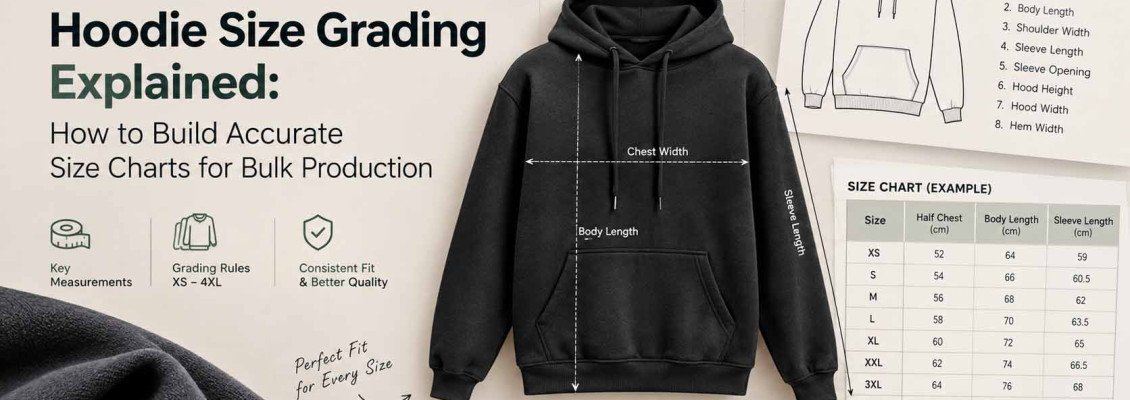
Hoodie Size Grading Explained: How to Build Accurate Size Charts for Bulk Production
Choosing the right hoodie design and fabric is only part of developing a successful clothing collection. For streetwear brands, fashion startups, and private-label apparel businesses, getting the sizing right is equally important.
A hoodie that fits perfectly in size Medium may not fit correctly when scaled up to XXL or down to XS. Sleeves can become too long, shoulders too wide, or the body proportions inconsistent if the size grading is not properly planned.
This is why hoodie size grading is an important step in custom hoodie manufacturing. It helps manufacturers create consistent garment proportions across a complete size range while preserving the intended fit and design.
Whether you are developing standard-fit sweatshirts, heavyweight oversized hoodies, cropped styles, or premium streetwear collections, a well-prepared hoodie measurement chart helps reduce fitting problems, improve customer satisfaction, and support smoother bulk production.
At Brand Stuff, we manufacture custom apparel for clothing brands and wholesale buyers. In this guide, we explain how hoodie size grading works, which measurements matter most, how to develop a size chart from XS to 4XL, and what brands should check before approving bulk production.
What Is Hoodie Size Grading in Apparel Manufacturing?
Hoodie size grading is the process of adjusting a base garment pattern to create additional sizes while maintaining the intended fit, proportions, and design.
For example, a clothing brand may develop an approved Medium hoodie and then require sizes XS, S, M, L, XL, XXL, 3XL, and 4XL.
Instead of creating every size from scratch, the manufacturer uses established grading rules to adjust selected measurements and generate patterns for the required sizes.
However, grading is not simply about making every part of a hoodie proportionally larger or smaller. Different garment measurements need different adjustments.
Chest width, body length, shoulder width, sleeve length, cuff opening, and hood dimensions may all require separate grading increments.
Why Is Size Grading Important for Custom Hoodies?
Accurate grading helps clothing brands maintain a consistent fit throughout their collections.
The main benefits include:
Consistent fit: Each size follows the intended silhouette.
Better customer experience: Customers can select sizes with more predictable measurements.
Fewer production errors: Clear specifications reduce confusion during pattern making and cutting.
Improved inventory planning: Brands can order a complete size range with greater confidence.
Reduced fitting complaints: Consistent measurements help minimise avoidable sizing issues.
For brands producing multiple hoodie styles, a reliable grading system also makes future product development more organised.
Size Grading Is Different From Choosing a Size Label
A garment labelled XL is not automatically the same size across every manufacturer.
One brand's oversized Medium may have a wider chest than another brand's XL. Different markets, fit preferences, and design specifications also influence garment measurements.
Why Clothing Brands Should Define Their Own Fit Standards
Rather than relying only on generic S–XL labels, brands should establish their preferred finished-garment measurements and document them in a tech pack.
The Practical Rule
Approve the actual garment measurements and fit before approving the size labels. Size labels communicate the intended size; the measurement chart defines the garment itself.
Hoodie Size Chart vs. Size Grading: What Is the Difference?
These terms are related, but they serve different purposes.
Term Meaning
Hoodie size chart A table listing the required measurements for each size
Base size The reference size used to develop the original approved pattern
Size grading The method used to adjust the pattern between sizes
Grade rule The specific measurement increment applied between sizes
Fit sample A garment used to evaluate fit, proportions, and construction
Size set Samples produced in multiple sizes to check the grading
For example, a brand might approve the Medium hoodie as its base size and specify the required chest, body length, sleeve length, and shoulder width for the remaining sizes.
The manufacturer then develops the graded patterns and checks whether the resulting garments match the approved size chart.
A complete hoodie size chart is therefore the target specification, while grading is the technical process used to achieve it.
Which Measurements Should a Hoodie Size Chart Include?
A useful hoodie measurement chart for manufacturers should cover the major dimensions that affect fit, appearance, and comfort.
The exact points of measurement should be clearly defined so that the brand and manufacturer measure the garment consistently.
1. Half-Chest Width
Half-chest width is commonly measured across the garment from one side to the other, at a specified point below the armhole.
It is one of the most important measurements because it influences how loose or fitted the hoodie feels around the upper body.
For oversized hoodies, chest width is often substantially larger than in regular-fit styles.
2. Body Length
Body length is generally measured from a defined point near the highest shoulder or neckline to the bottom hem.
The measurement method should be stated in the tech pack because different starting points can produce different results.
Body length affects whether a hoodie looks cropped, regular, longline, or oversized.
3. Shoulder Width
Shoulder width is measured between the specified shoulder points.
Dropped-shoulder streetwear designs require particular attention because the shoulder seam intentionally sits farther down the arm than it would on a conventional fitted garment.
4. Sleeve Length
Sleeve length must be measured using a consistent method, such as from the shoulder seam to the sleeve opening.
For dropped-shoulder garments, the shoulder seam position affects the apparent sleeve length. The measurement method must therefore match the actual construction.
5. Sleeve Opening and Cuff
The sleeve opening determines how wide the sleeve is at the wrist or cuff.
For hoodies with ribbed cuffs, brands should specify whether the measurement refers to the relaxed cuff, stretched cuff, or finished opening.
6. Hood Dimensions
Hood height, width, depth, and opening shape affect both comfort and appearance.
A deep, structured hood may require different proportions from a lightweight, close-fitting hood.
7. Hem Width
Hem width affects how the hoodie sits around the waist and lower body.
This is particularly important for cropped hoodies, boxy silhouettes, and designs with elasticated or ribbed waistbands.
8. Additional Measurements for Special Designs
Depending on the style, a more detailed chart may also include:
Armhole depth
Bicep width
Pocket width and height
Neck opening
Hood opening
Rib waistband height
Cuff height
Front zipper length
Drawcord length
For styles with unusual proportions, the tech pack should include a labelled measurement diagram so the factory knows exactly where each measurement begins and ends.
How to Create a Hoodie Size Chart From XS to 4XL
Developing a reliable size chart starts with the intended fit, not with a generic grading table.
A manufacturer needs to know how the hoodie should look on the wearer before determining how the pattern should change between sizes.
Step 1 — Choose the Base Size
Select one size as the reference for the initial pattern.
Many brands use Medium or Large, but the best choice depends on the target customer, market, and design.
The base size should have clearly defined measurements and a confirmed fit preference.
Step 2 — Define the Intended Silhouette
Decide whether the garment is:
Regular fit
Relaxed fit
Oversized fit
Boxy fit
Cropped fit
Longline fit
These silhouettes require different pattern proportions. An oversized hoodie should not be developed simply by adding the same amount of width and length to every size.
Step 3 — Set the Grade Rules
Grade rules specify how each measurement changes between adjacent sizes.
For example, a hypothetical half-chest width might increase by 2 cm between sizes, while body length increases by 1.5 cm.
These are illustrative increments, not universal industry standards. Actual grade rules must be determined from the approved base pattern, intended fit, target size range, and brand specifications.
Step 4 — Create the Full Size Chart
Once the grade rules are established, calculate the target measurements for all required sizes.
A typical size range may include XS, S, M, L, XL, XXL, 3XL, and 4XL.
However, each garment measurement may follow a different grading increment. The size chart should reflect those differences instead of applying one universal increment to every measurement.
Step 5 — Check the Graded Patterns
The pattern maker should check whether the graded patterns preserve the design's proportions.
For example, increasing the chest width without properly adjusting the armhole and sleeve may cause fit problems.
Likewise, a larger body does not automatically require the hood to grow at the same rate as the chest.
Step 6 — Validate Fit Before Bulk Production
Review the relevant sample sizes and confirm that the garments match the approved specifications.
For a broad size range, a size-set review can reveal problems that may not be visible when checking only the base size.
Example Hoodie Size Chart for Bulk Production
The table below is an illustrative example only showing how finished-garment measurements may be organised for a relaxed-fit hoodie.
It is not a universal size standard or a ready-to-use production specification. Measurements should be developed for the actual design and target market.
Size Half chest Body length Sleeve length
XS 52 cm 64 cm 59 cm
S 54 cm 66 cm 60.5 cm
M 56 cm 68 cm 62 cm
L 58 cm 70 cm 63.5 cm
XL 60 cm 72 cm 65 cm
XXL 62 cm 74 cm 66.5 cm
3XL 64 cm 76 cm 68 cm
4XL 66 cm 78 cm 69.5 cm
Measurement conventions: Half chest is measured flat across the garment. Body length and sleeve length require clearly defined starting and ending points in the production tech pack.
Notice that this example uses consistent increments for the listed measurements. In actual manufacturing, a brand may choose different increments or fit adjustments based on its approved pattern.
How to Read a Finished-Garment Measurement Chart
Half-chest measurements are not the same as the full chest circumference.
For example, a flat half-chest measurement of 56 cm corresponds to approximately 112 cm around the garment when measured across both sides, assuming a symmetrical garment and comparable measurement points.
This is a garment measurement, not a body measurement.
The difference matters because a wearer needs enough ease for movement and layering. The appropriate amount of ease depends on the fit, fabric, and intended use.
Oversized Hoodie Size Grading vs. Regular-Fit Grading
Oversized hoodies have become a staple of streetwear collections, but their grading needs careful planning.
Simply increasing the chest width and length does not always create a balanced oversized silhouette.
What Makes Oversized Hoodie Grading Different?
Oversized designs may feature:
Wider chest and body proportions
Dropped shoulders
Broader sleeves
Longer or deliberately cropped body lengths
Wider armholes
Larger hoods
Different hem and cuff proportions
A regular-fit hoodie may use a more conventional relationship between shoulder width, body width, and sleeve length.
An oversized hoodie may deliberately change those relationships to achieve a boxy or relaxed shape.
Should You Size Up or Use an Oversized Pattern?
Sizing up a regular-fit hoodie can make it larger, but it may not reproduce a professionally developed oversized silhouette.
The neckline, armhole, shoulder drop, sleeve proportions, and body length may not scale correctly.
For brands building a signature oversized collection, it is usually better to develop the intended silhouette as its own pattern and grade it from the approved base size.
How Fabric GSM and Shrinkage Affect Hoodie Sizing
Fabric selection is closely connected to garment fit.
A 400 GSM heavyweight cotton fleece hoodie can behave differently from a lighter French terry hoodie because fabric thickness, structure, stretch, and finishing affect how the garment hangs and feels.
Does Higher GSM Change the Size Chart?
GSM measures fabric weight per square metre. It does not directly determine garment measurements.
However, thicker or stiffer fabrics can affect drape, seam bulk, and how a garment feels when worn.
When changing from a lightweight fabric to heavyweight fleece, brands should assess whether the existing pattern still delivers the intended fit.
Why Fabric Shrinkage Must Be Considered
Cotton-rich fabrics may shrink during washing or finishing if they are not adequately controlled.
If the manufacturer uses unverified shrinkage assumptions, the final garment dimensions may differ from the approved measurements.
Brands should confirm whether measurements are specified before or after washing and finishing.
For a deeper explanation, read our guide: Hoodie Shrinkage Explained: How Fabric Shrinkage Affects Fit, Measurements & Bulk Production.
How to Prevent Size Variations During Production
To improve measurement consistency:
Confirm the fabric composition and finishing process.
Establish the measurement stage used in the tech pack.
Approve the sample before bulk production.
Check finished garments against the approved measurement chart.
Agree on measurement tolerances before production begins.
Fabric, pattern, washing, and finishing should be treated as connected parts of the product-development process.
How to Check Hoodie Measurements Before Approving Bulk Production
An approved base-size sample is an important starting point, but it does not automatically prove that every size is correct.
A manufacturer and clothing brand should establish a measurement-checking process before cutting the full order.
Review the Tech Pack
Ensure that the tech pack includes the correct measurements, measurement points, fit description, size range, fabric details, and construction notes.
If the design includes dropped shoulders, oversized sleeves, or a cropped body, those details should be clearly documented.
For help preparing these specifications, read our guide: How to Create a Tech Pack for Custom Hoodies (2026) | Complete Guide for Streetwear Brands.
Approve the Base Sample
Check the sample against the intended fit and measurements.
Review the chest, body length, shoulder, sleeve, hood, cuffs, and hem. Confirm that the fabric and construction match the planned production specifications.
Request a Size-Set Review When Appropriate
A size set consists of samples in multiple sizes for checking grading consistency.
For a collection covering XS to 4XL, reviewing selected sizes across the range can help identify disproportionate changes or fit problems.
The required size-set process depends on the order, design complexity, and agreement between the buyer and manufacturer.
Define Measurement Tolerances
Measurement tolerances specify how much variation from the approved measurement is acceptable.
The tolerances should be agreed upon in advance and may differ between measurements, fabrics, and garment types.
Without clear tolerances, the buyer and manufacturer may interpret acceptable variation differently.
Common Hoodie Size-Grading Mistakes to Avoid
Using a Generic Size Chart Without Checking Fit
Generic size charts can be useful for initial planning, but they should not replace a brand-specific measurement specification.
Applying the Same Increment to Every Measurement
Chest width, body length, sleeve length, shoulder width, and hood dimensions serve different functions. They do not necessarily require identical grading increments.
Confusing Body Measurements With Garment Measurements
A body measurement describes the wearer. A finished-garment measurement describes the clothing itself.
Mixing these two types of measurements can result in an incorrect fit.
Ignoring the Intended Market
Sizing expectations and fit preferences may vary by target customer and market. Brands should clearly communicate their preferred fit instead of relying on size labels alone.
Changing Fabric After Pattern Approval
A change in fabric composition, GSM, stretch, or finishing can affect garment behaviour. Any significant material change should be reviewed before proceeding with bulk production.
Approving Only One Size for a Wide Size Range
A correct Medium sample does not guarantee that XS, XXL, or 4XL will fit as intended.
When sizing consistency is important, plan appropriate grading and measurement checks across the range.
How Accurate Size Grading Helps Control Hoodie Manufacturing Costs
Size grading is not only a fit issue; it is also part of production planning.
Poorly developed patterns can lead to rework, additional sampling, measurement disputes, and avoidable delays.
Accurate specifications help the manufacturer plan cutting, stitching, and quality control more efficiently.
For brands preparing their first bulk order, the cost of sampling and fit corrections should be considered alongside fabric, decoration, packaging, and shipping.
For a broader costing breakdown, read our article: Custom Hoodie Pricing Breakdown 2026: Cost Per Unit, MOQs & Profit Margins for Streetwear Brands.
Frequently Asked Questions About Hoodie Size Grading
What is hoodie size grading?
Hoodie size grading is the process of adjusting a base garment pattern to create additional sizes while maintaining the intended fit and proportions.
How do manufacturers grade hoodies from XS to 4XL?
Manufacturers start with an approved base-size pattern, define grading increments for the relevant measurements, create the additional patterns, and check the results against the brand's size chart.
Is there a universal hoodie size chart?
No single size chart works for every brand or fit. Measurements vary according to design, target market, garment style, and the brand's sizing standards.
What measurements should a custom hoodie size chart include?
Common measurements include half chest, body length, shoulder width, sleeve length, cuff opening, hood dimensions, and hem width. Additional points may be required for specific designs.
Is an oversized hoodie size chart different from a regular-fit chart?
Yes. Oversized hoodies typically use different proportions, including a wider body, dropped shoulders, and broader sleeves. They should be developed around the intended oversized silhouette.
Should I create a size chart before ordering samples?
Yes. A preliminary size chart helps the manufacturer develop the pattern and sample. The measurements should then be reviewed and refined during sample approval before bulk production.
How can I reduce sizing problems in bulk hoodie production?
Provide a clear tech pack, approve the base sample, establish measurement tolerances, confirm fabric specifications, and arrange appropriate size-set checks for the planned range.
Can a manufacturer develop custom sizing for my clothing brand?
Yes. Custom sizing can be developed around your target customer, preferred silhouette, reference measurements, and approved design. The requirements should be confirmed before sampling and production.
Build Your Next Hoodie Collection With Brand Stuff
Accurate hoodie size grading helps clothing brands maintain a consistent fit, reduce avoidable production problems, and develop a more reliable customer experience.
Whether you're launching a new streetwear label, expanding an existing collection, or preparing a bulk private-label hoodie order, the process starts with a clear design, a detailed measurement chart, and an approved sample.
At Brand Stuff, we manufacture custom apparel for streetwear brands, fashion startups, and wholesale buyers. Our services include custom hoodie development, pattern making, cutting and stitching, printing, embroidery, and private-label branding.
We can review your design and specifications to help determine the next steps for your project.
Ready to Discuss Your Custom Hoodie Project?
To get started, prepare the following information:
Your hoodie design, reference images, or tech pack
Preferred fit: regular, relaxed, boxy, or oversized
Fabric composition and GSM
Required size range and measurement chart
Order quantity and size breakdown
Printing, embroidery, label, and packaging requirements
Delivery destination
Contact Brand Stuff to discuss your custom hoodie manufacturing requirements.
Website: https://brand-stuff.com/
Instagram: https://www.instagram.com/brandstuffpk/
Brand Stuff — Custom Apparel Manufacturing for Clothing Brands and Wholesale Buyers.
Leave a Comment