
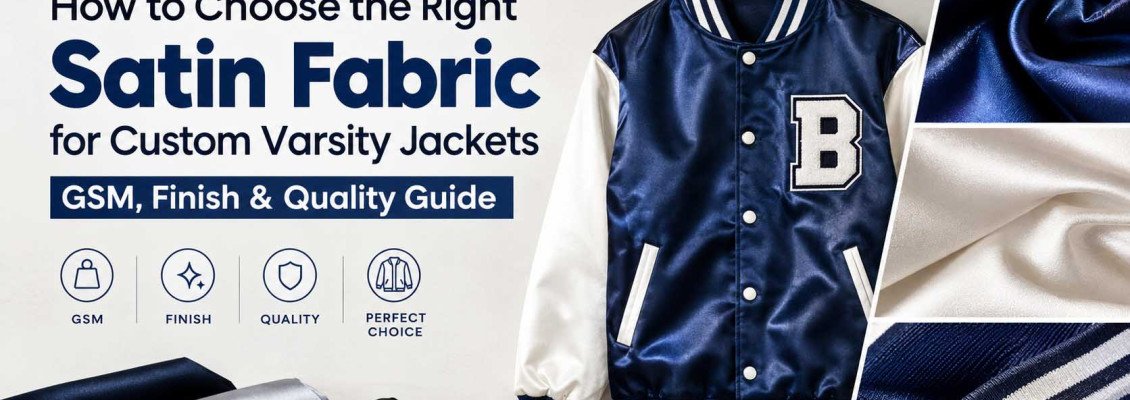
How to Choose the Right Satin Fabric for Custom Varsity Jackets: GSM, Finish & Quality Guide
Choosing the right satin fabric is one of the most important decisions when developing a custom varsity jacket. Fabric affects the jacket's appearance, shine, weight, drape, comfort, durability, and overall perceived quality.
For streetwear brands, fashion startups, sportswear labels, and private-label clothing companies, simply asking for "satin" is not enough. Different satin fabrics can have significant differences in GSM, fiber composition, finish, hand feel, structure, and performance.
This guide explains how to choose satin fabric for custom varsity jackets, including GSM, finish, quality, lining, color, durability, and decoration compatibility.
Whether you are developing a lightweight fashion jacket or a premium heavyweight satin varsity jacket, understanding these factors can help you make a better decision before sampling and bulk production.
What Is Satin Fabric for Varsity Jackets?
Satin is a type of fabric construction rather than one specific fiber. It is recognized by its smooth surface and characteristic light-reflective appearance.
Satin can be manufactured from different fibers. Polyester satin is a popular choice for custom varsity jackets because it can provide a combination of smoothness, durability, color performance, and commercially practical pricing.
A proper satin fabric specification should include more than simply the word "satin."
Important Satin Fabric Specifications
When sourcing satin for a varsity jacket, consider:
Fiber composition
GSM
Weave construction
Surface finish
Shine level
Hand feel
Drape
Color
Durability
Lining
Decoration requirements
Intended season
Why Satin Works Well for Custom Varsity Jackets
Satin has a distinctive appearance that works particularly well with fashion-oriented outerwear.
It can be combined with:
Embroidery
Chenille patches
Appliqué
Screen printing
Custom ribbing
Metal snaps
Woven labels
Embroidered logos
Satin for Streetwear Brands
Satin can give a relatively simple jacket silhouette a strong visual identity.
A satin shell combined with custom ribbing, embroidery, patches, and branded hardware can create a premium streetwear varsity jacket.
Satin for Private-Label Apparel
Private-label brands can customize more than just the jacket's logo.
A manufacturer can develop the:
Fabric
Color
Fit
Pattern
Ribbing
Hardware
Labels
Embroidery
Patches
Packaging
Why Fabric Selection Matters for Custom Satin Varsity Jackets
Fabric is one of the first things customers notice when they touch and wear a jacket.
A fabric that looks excellent in a photograph may feel too thin, overly stiff, excessively shiny, or less durable when made into a finished garment.
The fabric therefore needs to be evaluated as part of the complete jacket.
Fabric Affects Jacket Appearance
Satin reflects light differently depending on its construction and finish.
A high-shine satin can create a bold fashion appearance, while a matte or semi-gloss satin can provide a more understated and modern look.
Fabric Affects Jacket Structure
Fabric weight and construction influence how a jacket hangs on the body.
Lightweight satin generally provides more movement and drape, while heavier satin can provide additional structure.
Fabric Affects Durability
A varsity jacket may experience repeated wear, friction, movement, washing, and handling.
The fabric should therefore be evaluated for:
Surface stability
Abrasion resistance
Tear resistance
Colorfastness
Seam performance
General durability
Fabric Affects Manufacturing Cost
Fabric quality, special finishes, custom colors, recycled materials, lining, and other specifications can affect manufacturing costs.
For this reason, brands should establish their desired fabric specifications before requesting a final production quotation.
Understanding GSM in Satin Fabric
GSM means grams per square meter.
It is a measurement of fabric weight and is commonly used by apparel manufacturers when specifying materials.
However, GSM should not be treated as a direct measurement of quality.
Two satin fabrics with similar GSM can have completely different hand feels and appearances because of differences in:
Fiber composition
Yarn
Weave
Fabric density
Finishing
Surface treatment
What Satin GSM Is Best for Varsity Jackets?
There is no universal GSM that is best for every varsity jacket.
The appropriate weight depends on the desired silhouette, season, lining, decoration, climate, and brand positioning.
Fabric Weight General Character Potential Application
Lightweight satin Soft and fluid Lightweight fashion jackets
Midweight satin Balanced drape and structure Streetwear varsity jackets
Heavyweight satin More substantial and structured Premium statement jackets
Lightweight Satin
Lightweight satin can be suitable for:
Spring collections
Transitional weather
Lightweight streetwear
Oversized silhouettes
Layering
Fashion-focused jackets
Midweight Satin
Midweight satin can provide a balance between:
Structure
Drape
Comfort
Appearance
Everyday wearability
For many streetwear applications, this can be a versatile option.
Heavyweight Satin
Heavyweight satin can be considered when a brand wants:
A substantial hand feel
More structure
Premium outerwear positioning
A statement silhouette
Strong visual presence
Does Higher GSM Mean Better Satin Quality?
No.
Higher GSM means the fabric is heavier, but it does not automatically mean it is better quality.
A premium lightweight satin can be more appropriate for a particular design than a poor-quality heavyweight fabric.
What Should Buyers Evaluate Instead?
Instead of asking only:
"What is the highest GSM satin?"
ask:
"What GSM, finish, construction, and hand feel are appropriate for my jacket?"
Why Physical Fabric Testing Matters
A physical fabric swatch allows a buyer to evaluate the actual material rather than relying only on a GSM number or photograph.
How to Choose the Right Satin Finish
The finish is one of the most important characteristics of satin.
It determines how strongly the fabric reflects light and can significantly change the appearance of a finished varsity jacket.
High-Shine Satin
High-shine satin has a strong reflective surface.
It can work well for:
Statement streetwear
Retro collections
Fashion drops
Music merchandise
Bold colorways
Limited-edition jackets
Advantages of High-Shine Satin
Strong visual impact
Eye-catching appearance
Vibrant colors
Distinctive fashion aesthetic
What Should You Watch For?
Very reflective satin can make wrinkles, creases, and surface imperfections more noticeable.
Best Use for High-Shine Satin
High-shine satin is particularly suitable when the goal is to create a bold, attention-grabbing statement jacket.
Matte Satin
Matte satin provides less reflection and a more understated appearance.
It can work well for:
Minimalist streetwear
Premium collections
Neutral color palettes
Contemporary designs
Subtle branding
Semi-Gloss Satin
Semi-gloss satin sits between high-shine and matte finishes.
It can provide a balance of:
Satin character
Moderate reflection
Versatility
Contemporary appearance
Polyester Satin vs. Other Satin Fabrics
When sourcing satin, always ask about fiber composition.
"Satin" itself is not a fiber specification because satin describes the construction or weave.
Polyester Satin
Polyester satin is widely used for commercial fashion and outerwear applications.
Potential advantages include:
Smooth surface
Attractive sheen
Durable synthetic fiber
Strong color possibilities
Lightweight options
Commercially practical pricing
Compatibility with various decoration methods
When Should a Brand Consider Polyester Satin?
Polyester satin can be a practical choice when a brand wants a combination of fashion appearance, durability, color options, and production efficiency.
How to Check Satin Fabric Quality Before Sampling
Never evaluate satin quality based on GSM alone.
A professional apparel buyer should assess several characteristics before approving the material.
1. Check the Hand Feel
Touch the fabric and evaluate whether it feels:
Smooth
Soft
Crisp
Fluid
Substantial
Consistent
2. Check the Surface
Inspect the fabric under different lighting.
Look for:
Consistent shine
Even surface
No obvious defects
No unusual streaks
Consistent reflection
3. Check the Drape
Hold the fabric vertically and observe how it falls.
Lightweight satin generally moves more freely, while heavier satin tends to provide more body.
4. Check Color Consistency
Color consistency is especially important for branded collections.
If your brand has a specific color identity, provide a suitable color reference during development.
5. Check Colorfastness
Ask your manufacturer about appropriate colorfastness testing based on the intended product and care instructions.
6. Check Surface Durability
Look for potential:
Snagging
Pulling
Abrasion
Pilling
Surface damage
Excessive creasing
7. Check Sewing Performance
Satin has a smooth surface and can require careful handling during cutting and sewing.
The manufacturer should assess the fabric during actual garment construction.
8. Check Decoration Compatibility
This is particularly important when your jacket includes large embroidery, chenille patches, or appliqué.
Choosing Satin for Embroidery and Chenille Patches
Varsity jackets often use embroidery, chenille, appliqué, or combinations of different decoration methods.
The satin fabric should be selected with those requirements in mind.
Satin and Embroidery
Large or dense embroidery can place additional stress on lightweight satin.
Before bulk production, evaluate:
Artwork size
Stitch density
Embroidery location
Stabilization
Fabric weight
Backing requirements
Large Back Embroidery
Large back embroidery is one of the most important areas to test during sample development.
The fabric and construction need to support the embroidery while maintaining a clean appearance.
Chest Embroidery
Smaller chest logos generally place less stress on the fabric, although embroidery density and construction should still be tested.
Why Embroidery Testing Matters
A sample allows the manufacturer and brand to confirm that the embroidery does not cause unwanted puckering, distortion, or tension problems.
Satin and Chenille Patches
Chenille patches are strongly associated with traditional varsity jackets.
They can be used for:
Letter patches
Team logos
Initials
Mascots
Brand symbols
Large back designs
Choosing the Right Lining for a Satin Varsity Jacket
The satin shell is only one component of the finished jacket.
The lining influences:
Comfort
Layering
Internal appearance
Garment structure
Ease of wearing
Lightweight Jacket Lining
For lightweight jackets, a lighter lining can help maintain the intended lightweight construction.
Quilted or Insulated Lining
For colder markets, quilted or insulated lining can provide additional warmth.
Shell and Lining Should Be Developed Together
The shell fabric should not be selected independently from the rest of the jacket.
The finished garment should be considered as a combination of:
Shell
Lining
Ribbing
Hardware
Pattern
Decoration
Construction
How to Choose Satin Based on Your Brand Style
Different brands can require very different satin specifications.
Minimalist Streetwear
Consider:
Semi-gloss satin
Clean embroidery
Simple branding
Neutral colors
Refined hardware
Premium Streetwear
Consider:
Premium hand feel
Controlled shine
Quality lining
Custom hardware
Detailed embroidery
Chenille
Custom labels
Retro Varsity Style
Consider:
Traditional satin appearance
Contrast ribbing
Bold embroidery
Chenille lettering
Retro color combinations
Statement graphics
Common Mistakes When Choosing Satin Fabric
Choosing GSM Without Testing the Fabric
A number cannot communicate everything about a fabric.
Always evaluate the actual material.
Assuming Shiny Means Premium
A highly reflective surface can look attractive, but shine alone does not determine quality.
Ignoring the Lining
The lining contributes significantly to comfort and garment construction.
Choosing Fabric Before Decoration
Heavy embroidery and patches should be considered before finalizing the fabric.
Approving Fabric From Photos Only
Photography and lighting can change the appearance of satin.
A physical swatch provides a much better reference.
Choosing Only Based on Price
The cheapest fabric may reduce initial manufacturing costs but can negatively affect:
Customer perception
Durability
Product reviews
Repeat purchases
Brand reputation
7 Questions to Ask Your Custom Satin Varsity Jacket Manufacturer
Before approving your material, ask your manufacturer:
1. What Is the Fiber Composition?
Confirm exactly what the fabric is made from.
2. What Is the GSM?
Ask for the actual fabric weight.
3. What Finish Does It Have?
Confirm whether the fabric is:
Glossy
Semi-gloss
Matte
Specially finished
4. Can You Send a Fabric Swatch?
A physical swatch is recommended before sample approval.
5. How Does the Fabric Perform With Embroidery?
This is important if your design includes large or dense embroidery.
6. What Lining Would You Recommend?
The manufacturer should recommend lining based on the intended use and season.
7. Can You Develop a Pre-Production Sample?
A pre-production sample allows you to evaluate the complete jacket before committing to bulk production.
Why Sampling Is Essential Before Bulk Production
A fabric specification provides useful information, but it cannot completely replace a physical sample.
During sample approval, evaluate:
Fabric weight
Hand feel
Shine
Color
Drape
Fit
Ribbing
Lining
Hardware
Embroidery
Patches
Stitching
Labels
Overall construction
Sample Approval Checklist
Fabric
Fiber composition confirmed
GSM confirmed
Hand feel approved
Drape approved
Surface finish approved
Color
Color approved
Shine level approved
Color consistency checked
Construction
Size chart approved
Pattern approved
Ribbing approved
Hardware approved
Lining approved
Branding
Neck label approved
Size label approved
Care label approved
Hang tag approved
Packaging approved
Decoration
Embroidery approved
Chenille approved
Appliqué approved
Printing approved
Custom Satin Varsity Jacket Manufacturing With Brand Stuff
At Brand Stuff, we manufacture custom cut-and-sew apparel for streetwear brands, fashion startups, sportswear companies, and private-label businesses.
Our custom satin varsity jacket development can include:
Fabric selection
Pattern making
Cutting
Stitching
Custom ribbing
Embroidery
Chenille patches
Appliqué
Screen printing
Custom labels
Hang tags
Packaging
Quality control
Bulk manufacturing
We can work from tech packs, mockups, artwork, reference garments, or design concepts.
Learn More About Satin Varsity Jacket Manufacturing
If you are planning a complete jacket collection, read our previous article:
Custom Satin Varsity Jacket Manufacturing: From Concept to Bulk Production
This article covers the broader manufacturing process from concept development through sampling and bulk production.
Explore More Satin Varsity Jacket Customization Options
You can also read:
10 Customization Options That Make Satin Varsity Jackets Stand Out
This article explores ways brands can combine embroidery, patches, printing, ribbing, labels, and other details.
Satin Varsity Jacket Fabric Selection Checklist
Before approving a fabric for production, confirm the following.
Fabric Specifications
Fiber composition
GSM
Weave
Finish
Hand feel
Drape
Appearance
Shine level
Color
Surface consistency
Color matching
Performance
Durability
Colorfastness
Abrasion resistance
Sewing performance
Construction
Lining
Ribbing
Hardware
Pattern
Fit
Decoration
Embroidery
Chenille
Appliqué
Printing
Final Thoughts on Choosing Satin Fabric
The right satin fabric is not necessarily the heaviest, cheapest, or shiniest option.
The best fabric is the one that supports the design, target market, season, decoration, fit, and brand positioning.
When choosing satin for a custom varsity jacket, evaluate:
GSM
Fiber composition
Finish
Shine
Hand feel
Drape
Color
Durability
Lining
Decoration compatibility
Most importantly, do not make your final decision based only on a specification sheet or photograph.
Request a fabric swatch and develop a physical sample before bulk production.
A carefully selected fabric combined with accurate pattern development, quality construction, professional decoration, and proper QC can make a significant difference to the finished jacket.
Frequently Asked Questions About Satin Varsity Jacket Fabric
What GSM Is Best for a Satin Varsity Jacket?
There is no universal GSM. The appropriate weight depends on the desired silhouette, season, lining, decoration, climate, and brand positioning.
Is Polyester Satin Good for Varsity Jackets?
Yes. Polyester satin can be a practical choice for custom varsity jackets because it can offer a smooth surface, attractive sheen, durability, and commercially practical production costs.
Does Higher GSM Mean Better Satin Quality?
No. GSM measures fabric weight rather than overall quality. Hand feel, construction, finish, durability, color, and surface quality should also be evaluated.
What Is the Difference Between Glossy and Matte Satin?
Glossy satin has stronger light reflection and a more dramatic appearance. Matte satin has less reflection and provides a more understated look.
Is Satin Good for Streetwear Varsity Jackets?
Yes. Satin is particularly suitable for fashion-oriented varsity jackets because it creates a distinctive appearance and works well with embroidery, patches, ribbing, and other customizations.
Can Satin Varsity Jackets Have Embroidery?
Yes. Satin varsity jackets can be embroidered, but large or dense embroidery should be tested during sample development to ensure the fabric and construction can support the design.
Can Chenille Patches Be Used on Satin?
Yes. Chenille patches can be incorporated into satin varsity jackets and are particularly suitable for traditional varsity-inspired designs.
Should I Choose Satin Based Only on GSM?
No. GSM should be considered together with fiber composition, finish, hand feel, drape, durability, color, lining, and decoration requirements.
Should I Order a Sample Before Bulk Production?
Yes. A physical sample allows you to evaluate the fabric, fit, construction, color, branding, embroidery, patches, and overall quality before committing to bulk production.
Can Satin Varsity Jackets Be Made for Private-Label Brands?
Yes. Private-label satin varsity jackets can be customized with branded labels, size labels, care labels, hang tags, packaging, embroidery, patches, and other brand-specific details.
Ready to Develop Your Custom Satin Varsity Jacket?
The right satin fabric is the foundation of a successful varsity jacket, but the final result depends on much more than fabric alone.
If you already have a tech pack, artwork, reference jacket, color idea, or design concept, Brand Stuff can help you develop the fabric, pattern, branding, decoration, sampling, and bulk production.
Send Us Your Jacket Requirements
For a quotation, provide:
Jacket design or reference
Preferred satin finish
Preferred GSM, if known
Quantity
Size breakdown
Artwork/logos
Embroidery or patch requirements
Branding requirements
Delivery country
Start Your Custom Jacket Development
Brand Stuff — Custom Apparel Manufacturer Since 2016
Develop your next custom satin varsity jacket collection with a manufacturing partner focused on custom cut-and-sew production, private labeling, quality control, and bulk apparel manufacturing.
Leave a Comment